German Security Service
The Collini CaseThe German Security Service is presented as part of the Nazi apparatus of occupation and repression in Italy, with a presence in Genoa and a detachment in Milan. Its importance in the novel lies in the way its paperwork and personnel connect a family’s search for an arrested man to a system of imprisonment and reprisal killings—and, decades later, to a revelation in court.
Identity and Presence
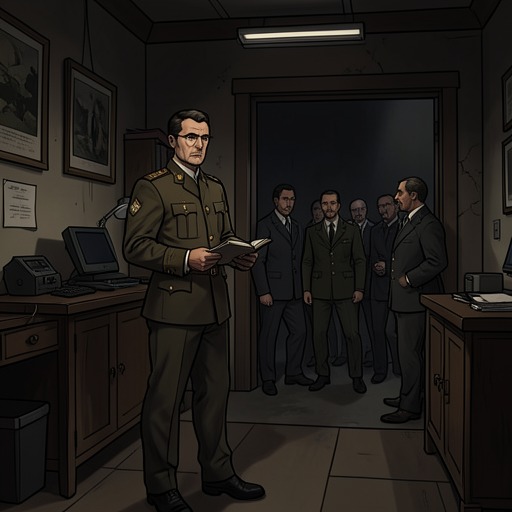
The novel depicts the Service through its offices, orders, and officers rather than offering a formal account of its organization. In Genoa, a new German takes over a Nazi office and runs it like a business venture, while being tasked with suppressing strikes in local industries needed for war production. The account identifies him as Hans Meyer. Elsewhere, an official document attributes an arrest to the Security Service detachment posted in Milan, indicating that the apparatus operated across more than one city. The document that reaches Fabrizio Collini’s family is thin, stamped with swastikas, and marked as coming from the Security Service. It names the prison in the Marassi district of Genoa and identifies the German now in charge of prisoners as SS-Sturmbannführer Hans Meyer. The family learn that Fabrizio’s father has been arrested by order of the Milan detachment; the official sheet turns an absence into a traceable act of state power.
Arrest, Prison, and Reprisal
The Service’s coercive reach is also visible in the interpreter’s history. After German forces find him hiding in a warehouse, they discover that he speaks South Tyrolese German and tell him that he must either go to prison or work as their interpreter. The choice makes translation part of the machinery of occupation: he is compelled to carry its orders between German officers and Italian prisoners. Weeks later, the head of Department V, identified as criminal investigation, orders the interpreter to report to Marassi Prison before a reprisal operation. He has not been told what will happen, but has already guessed that the bombing of Café Trento will bring an uncompromising response. At three in the morning, he receives a list of twenty prisoners and must call out their numbers, not their names. None has had anything to do with the bombing. The prisoners understand from the false explanation that they are being moved that they are going to die. The prison scene places Department V and the Security Service within the same repressive apparatus, but does not fully specify their formal chain of command. A truck waits under floodlights; four armed men in marine uniforms guard the prisoners. Hans Meyer joins the interpreter and the officer in charge of the marines in a jeep. Meyer refers to Hitler’s orders, General Kesselring, and a reprisal ratio of ten dead partisans for each German soldier killed. The sequence shows how bureaucratic instructions, coerced interpretation, prison administration, and armed personnel converge in the preparation of a mass killing.
Exposure in Court
The Security Service’s surviving paperwork becomes decisive evidence in the later trial. When Caspar Leinen reads aloud the name SS-Sturmbannführer Hans Meyer, spectators gasp and reporters leave the press bench to telephone their newsrooms. The name on the stamped document links the arrest of Fabrizio’s father to the man whose wartime authority the narrative has been tracing. In this way, the Service is more than background institution: its records preserve a connection between wartime violence and the present-day courtroom, where a buried history suddenly becomes public.